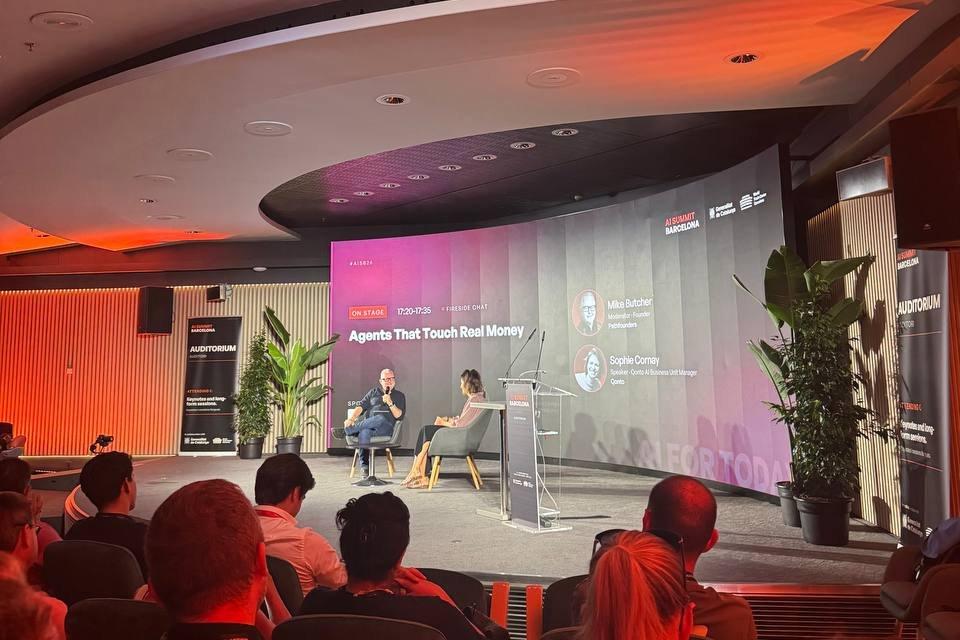
The biggest enterprise AI trends in 2026 have little to do with which model is best. That was the clearest message from AI Summit Barcelona 2026, held on September 22–23 at WTC Barcelona. The sessions kept returning to production AI, AI agents, enterprise adoption, edge and local inference, and AI ROI you can actually measure.
Dozens of independent talks reached the same conclusion, and it fits in two sentences. In 2026, the problem with AI is no longer that models aren’t good enough. The problem is that most companies still struggle to wire them into real workflows, give them the right context, keep cost and reliability under control, and rebuild processes so AI shows up in the P&L.
Value is moving away from teams that build “one more model.” It is moving toward teams that know where AI fits in a business, how to verify it works, how to cut its cost, and how to scale it in production. Below are the patterns we saw, the cases and numbers behind them, and what they mean for companies planning AI budgets for 2027.
Key Takeaways: Enterprise AI Trends 2026 at a Glance
- Integration beats models. Frontier models are strong and are becoming a commodity through open source and model routing. Competition has moved to agents, context, data architecture, workflow redesign, edge inference, evaluation, and unit economics.
- Copilots make “faster caterpillars.” Real enterprise AI ROI starts when companies redesign end-to-end workflows, not when every employee gets a chat window.
- Context beats model choice. Knowledge graphs, memory, and semantic layers are becoming core AI infrastructure.
- Cloud-only AI is ending. Inference is moving toward hybrid AI architecture that combines local, edge, and cloud, with routing between them.
- Building got about 10× easier; selling didn’t. Technical execution alone is no longer a moat.
- Evaluation is infrastructure. How fast you learn whether a project works decides how fast the project moves.
1. Enterprise AI Adoption Is Moving from Copilots to Workflow Redesign
The clearest thread across the summit was a three-stage evolution in how enterprises use AI.
- Personal productivity. AI writes the email, the summary, the code snippet, the slide. This saves time, but saved time doesn’t automatically become money.
- Task automation. An agent answers the call, a coding agent ships the feature, an AI runs the interview.
- Workflow orchestration. AI spans several systems, people, decisions, and handoffs, and carries the work end to end.
Most enterprise AI budgets still sit in stage one. The ROI that keynote speakers presented came from stage three.
2. The Coordination Tax: Why Copilots Alone Don’t Deliver Enterprise AI ROI
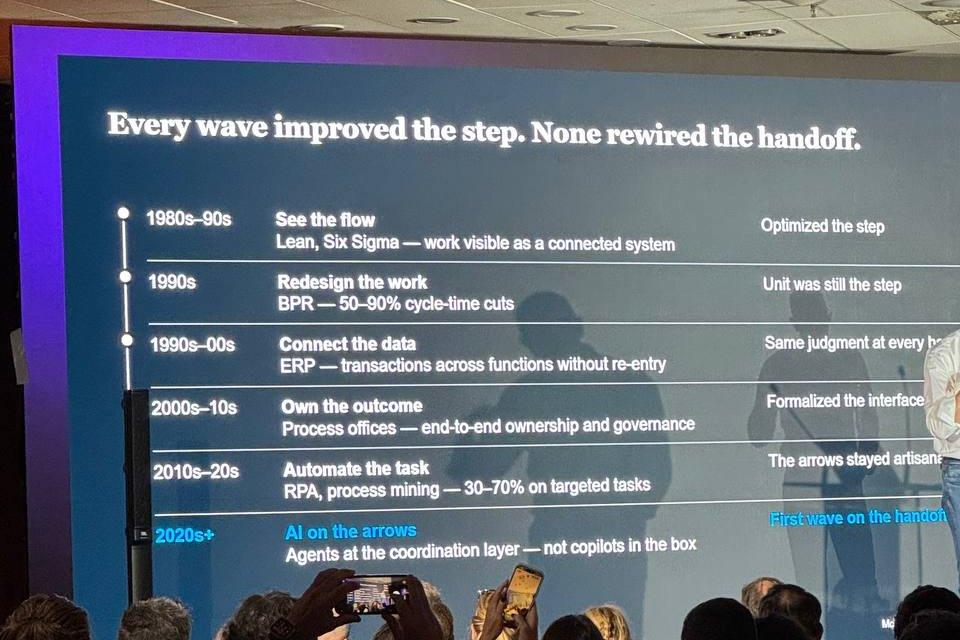
One of the strongest strategy sessions argued that companies spent decades optimizing individual tasks and almost never optimized the handoffs between people and systems. One slide put the gap in numbers: roughly 9–18 days of interface latency against 12–24 hours of actual work. That is about a 9:1 ratio of coordination to work.
This is why a copilot that makes an employee 30% faster produces what the speaker called a “faster caterpillar.” The caterpillar is quicker, but it is still a caterpillar. The butterfly only appears when the company changes the workflow and the structure around it.
The practical formula the speaker offered was simple. Take one end-to-end workflow, assign one P&L owner, and organize the team around the outcome rather than around functions. Agents take over coordination, while people keep judgment, objectives, exceptions, and constraints. In other words, AI belongs on the arrows between the boxes, not only inside them.
Other enterprise talks reinforced this point from different directions.
- Measure ROI, not adoption. Counting how many employees use ChatGPT is not a success metric. The metric is the moment the promised ROI appears in financial results. One enterprise target presented on stage was 5× ROI over three years.
- Bottom-up needs governance. Grassroots experimentation is necessary. Without central governance, though, it produces “modern macros”: hundreds of local solutions that can never scale.
- The enterprise layer is a product. Zurich presented its internal AI platform with centrally approved model access, usage and cost visibility, spending alerts, caps, and guidance. They stress-tested it with a hackathon of 700+ people. Routing, governance, cost accounting, and security around models are becoming products in their own right.
- The value gap is a disconnect. Aily’s session, The AI Enterprise Value Gap, described companies spending heavily on AI while seeing almost no P&L impact. The cause was that data, forecasts, decisions, and execution live in separate places. Their answer is an operating layer that closes the loop from data to insight to decision to action.
3. AI Agents in Production Aren’t Chatbots
The word “agent” was everywhere in Barcelona, so it helps to separate hype from the real shift. In production, an agent is not a chatbot with a personality. It is a system that runs a chain: Goal → Context → Reasoning → Tools → Action → Validation → Memory/Evaluation.
Each link in that chain is becoming its own infrastructure market. That list includes context engineering, memory, MCP and tools, orchestration, observability, evals, approval flows, agent identity, model routing, security, and cost control. A large software layer is forming around the models themselves.
The production cases showed both the upside and the operational reality.
- Naturgy’s voice agent handled around 250,000 technical customer-service calls. Roughly half could be resolved without a human, with CSAT around 9.3/10. Production also surfaced accents, background noise, latency, spoken numbers, and process ambiguity that never appeared in testing. The lesson is that voice AI is production-ready, but it is a continuous product rather than something you deploy and forget. Human audits, weekly reviews, A/B tests, and instant escalation to a person are part of the system.
- Conversation Bench tests voice agents by having a real agent talk to a simulated caller while rules and a validator score the result. It is a strong idea for agent QA. The session also showed its limit: synthetic callers can behave too “politely,” so a benchmark can miss real failure modes. Production traces and human audit are still needed.
- Everfin with Claude Code. In enterprise software engineering, features per developer per month rose from about 0.8 to 2.1. Changes per release went from 16 to 40, and test coverage rose by 400%. The estimated AI ROI was 4–8×. The winning model was not “AI replaced the developer.” It was “the developer stays accountable while AI dramatically expands throughput.”
- Autentic AI runs multilingual, asynchronous qualitative research interviews: about 8 million interviews, more than 1,000 per week, with a typical interview lasting around 48 minutes. It is a good example of a vertical agent. It is not a chatbot but a full business workflow covering recruitment, interview, follow-up, and insights.
4. Knowledge Graphs for AI Agents: Context Beats Model Choice
Neo4j, Blitzy, the memory-graph sessions, Agent Skills, and Aily all described the same problem from different angles. An LLM without well-organized knowledge context doesn’t know your business.
First-generation RAG looked like this: documents → chunks → vectors → similarity search → LLM.
The next generation looks more like this: entities + relationships + rules + history + permissions + workflows + semantic layer → agent.
Several sessions made the case concretely.
- Neo4j, “Thinner agents on a smarter knowledge substrate.” An LLM should not have to guess how hundreds of enterprise tables relate to each other. A graph defines entities, relationships, and semantics, and enables multi-hop reasoning.
- Blitzy is a coding agent that builds a dependency graph of the codebase before generating any code. For complex agents, context quality often matters more than a stronger model.
- Skill distillation. Instead of storing what an agent learned as prose, you can convert its traces and memory graph into a deterministic, typed execution graph with provenance. The agent accumulates operational knowledge, and that knowledge stays inspectable, versioned, and auditable. Drift can be detected and skills updated.
- Albatross AI and Wallapop showed the same logic in recommendations. Classic recommender systems depend on popularity, item IDs, and user history, so a new product with no clicks is effectively invisible. Perception models read the live session, the item’s content, and the user’s current intent. Content embeddings of new items are projected into behavioral space, so an item can be recommended before it has any interaction history, without retraining the model each time. Albatross reports working with tens of billions of predictions a year across more than 150 million products. Recommendation is turning into a real-time intent engine rather than “people like you also bought.”
This is why knowledge graphs now look less like a database trend and more like an AI infrastructure trend. It is also the direction of INC4’s own research: our interaction-native knowledge harness cut agent latency by 82.95% and stale-knowledge usage by 96.58% by moving memory work out of the agent’s critical path.
5. Hybrid AI Architecture: Why Cloud-Only AI Is Ending
HP, Tether’s QVAC, llama.cpp, and the small-model sessions all pointed the same way. The cloud will remain the place for training, frontier-level reasoning, very large context, and burst capacity. A growing share of inference, though, is moving to local, edge, and on-prem setups, for five reasons: privacy, latency, offline operation, predictable cost, and data sovereignty.
- HP framed its sessions around edge intelligence and the “physics” pulling AI to the edge. Manufacturing vision streams, sensitive data, and low-latency workloads stay local, while the cloud handles training, frontier reasoning, and burst GPU demand. The next stage is not “cloud or local.” It is hybrid AI orchestration, where each workload runs on the right hardware.
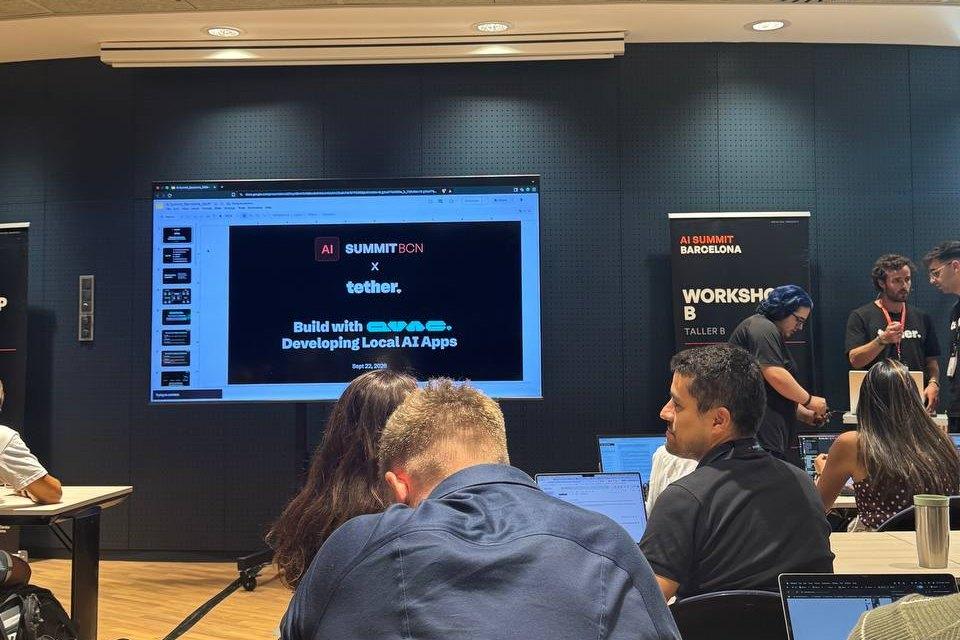
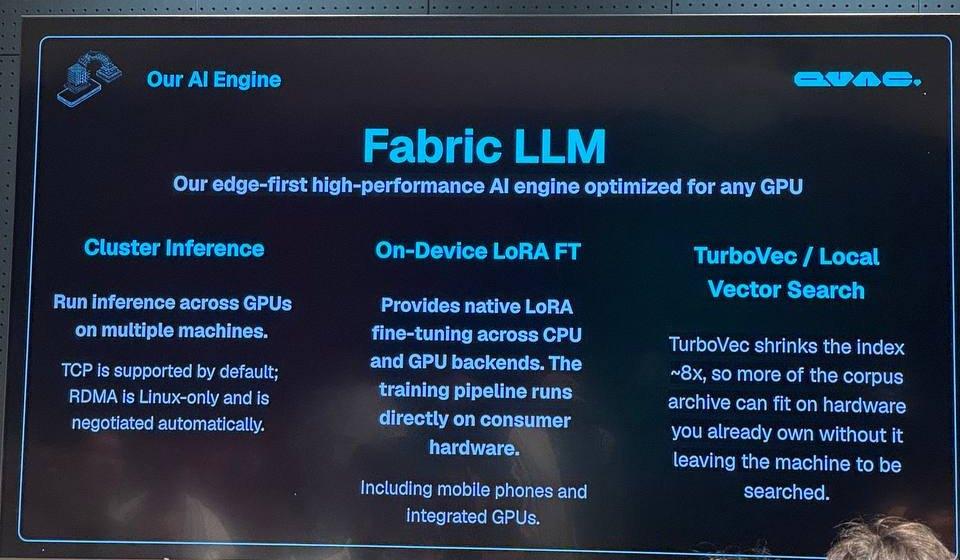
- Tether’s QVAC is an open-source, local-first AI platform. It runs LLM, vision, speech, RAG, and generation workloads locally without cloud dependencies or API keys, with JS/TS and Python SDKs and P2P, cross-platform support. It is one of the cleanest examples of AI moving onto the device. Its purpose-built edge models (MedPsy, VisionPsy, TranslatePsy) optimize for a specific edge use case rather than competing on parameter count. QVAC Genesis, a synthetic STEM training dataset, has reached 339B tokens across 19 STEM domains over three releases, which shows synthetic data becoming its own layer of model infrastructure. The QVAC Fabric LLM and TurboVec stack adds cluster inference, on-device LoRA fine-tuning, and local vector search with roughly 8× index compression. Local RAG and fine-tuning are now a normal consumer and enterprise architecture rather than a research demo.
- Small and quantized models. Sessions on Gemma, Qwen, and ternary or quantized models made the point that a small model tuned for one task can be far cheaper and still strong enough. “The biggest model everywhere” is no longer a default architecture decision. Cost, latency, privacy, and task complexity will decide model routing.
The resulting hybrid AI architecture has three tiers.
| Tier | Model | Handles |
|---|---|---|
| Local | Small, task-specific model | Routine and private tasks |
| Company | Medium or open-weight model | Internal company workloads |
| Cloud | Frontier model | Only the hardest reasoning |
A routing layer decides where each request goes. The result is cheaper, more private, faster, and less dependent on any single vendor at the same time. For the economics behind that decision, see our breakdown of cloud GPU vs bare metal vs colocation.
6. Open Source and Model Routing Make Vendor Lock-In Optional
Large models are becoming a commodity layer faster than expected. A development team can now choose between OpenAI, Anthropic, Gemini, open-weight models, local models, and small task models. It can then route each task by quality, latency, privacy, and cost.
Open models combined with open runtimes such as llama.cpp and frameworks such as Mastra, an open-source TypeScript layer for agents, workflows, memory, evals, observability, and multi-provider routing, sharply reduce dependence on one vendor. Competitive advantage will not come from access to GPT or Claude. It will come from architecture, data, integration, UX, and distribution.
7. AI Apps and MCP: A New Distribution Layer
One of the most underrated threads was the rise of apps that live inside AI assistants. Skybridge is a full-stack TypeScript framework for MCP, ChatGPT, and Claude apps. An agent calls a tool, receives structured data, and a full React UI renders inside the conversation. Alpic Atlas already indexes more than 6,000 AI apps, with hundreds of new ones each week.
The distribution path is changing.
- Before: browser → website / mobile → app
- Now: AI assistant → tool / MCP → interactive AI app
It is not certain that assistant app directories will become the next App Store. Still, “build for agents” and “build inside AI assistants” are worth testing now, while the market is early and first-mover experience is cheap to get.
8. Building Got 10× Easier. Selling Didn’t.
Vincent Jong of Poolside Ventures asked whether one person can now build companies with AI, and answered with his own experiments. Meet.bot took 12 months to build. DataMerge took four weeks, as did SCOPY, which was built entirely with Claude Code. DataMerge earned around €40K in 2026 but was shut down after its product-led growth model didn’t hold up. SCOPY found early revenue, and its workshops worked as a sales channel. His session’s summary line was that building got 10× easier, but selling didn’t.
The startup bottleneck used to be “How many developers do we need to build this?” More and more, it is “Does anyone need this, and how will we sell it?”
The implication for everyone, not just founders, is that software supply is rising sharply. “We can build software fast” is no longer enough to stand out. What gains value instead is domain expertise, proprietary data, distribution, integration, workflow ownership, regulatory know-how, and trust.
9. Where the Moat Is in Enterprise AI Now
The most important business takeaway from Barcelona is that “we have the best model” is becoming a weaker moat every quarter. The stronger moat is a combination:
Proprietary workflow + proprietary context and data + integrations + distribution + accumulated feedback and evaluations + trust
The most interesting version is the learning workflow. When an agent runs a workflow thousands of times, the company accumulates failure traces, exceptions, human corrections, successful trajectories, and company-specific knowledge. That material becomes Agent Skills, eval datasets, rules, and graph memory. The product then actually improves with use, and a competitor can’t copy it by switching to the same model.
The flip side is a list of things with very little moat: generic chatbots, generic “AI assistants for companies,” thin wrappers over a single model API, generic RAG over PDFs, and “AI employees” that are really only a chat interface. When build cost falls this fast, technical implementation alone stops being an advantage.
10. AI Agent Evaluation Is Core Infrastructure, Not the Last Step
Building an agent today is easy. Building one that a CFO, a COO, or a head of customer service will allow to run 100,000 real operations is much harder. That gap is creating a serious B2B infrastructure market for AI agent evaluation. It includes production tracing, test cases, synthetic users, replay, regression evaluation, human review, latency and cost monitoring, and model comparison.
"As fast as you can find indicators that it is working or not, as fast will be your project."
Evaluation should not be the final stage of an AI project. It is the infrastructure that sets the project’s speed. We made the same argument for trading systems in Why Execution Is the Real Risk in Agentic Trading: what makes agents deployable is the safety and measurement layer around the model.
11. People: Analyze Tasks, Not Job Titles
The workforce sessions offered a useful frame: analyze tasks, not job titles. Some tasks get automated, some professions get reorganized, and some grow. The variable that decides the outcome is not how fast AI develops but how ready people and companies are.
A new role is also forming. The most valuable specialist will not be the best prompter. It will be the person who can look at a company and say:
- AI isn’t needed here;
- a small local model is enough here;
- this step needs a frontier model;
- this needs to be automated end to end;
- this step must keep human approval;
- this metric will show within two weeks whether the project works;
- and this is what it costs per completed operation.
The role sits where business process, product, AI architecture, and economics meet, and it will matter more than “AI developer” alone.
The Big Picture: Where Enterprise AI Is Heading
If you compress the whole summit into one evolution, it reads like this.
2023–24: Chat with AI → 2024–25: Copilots → 2025–26: Agents → Now: Agents connected to real systems → Next: AI-native workflows and organizations
In parallel, the same shift is running through every layer of the stack.
- Infrastructure: one huge cloud LLM → multi-model routing → small, open, and local models combined with frontier cloud models
- Data layer: RAG → semantic layer, knowledge graph, and memory
- Development: a human builds software with AI help → an agent builds much of the software while a human defines the product and validates it
- Measurement: AI adoption → AI ROI
- Workforce: “AI saves me 30 minutes” → “Why does this workflow need to exist in this form at all?”
What This Means for Your AI Roadmap
AI Summit Barcelona 2026 showed an industry moving from a model race to an integration race. The companies that win will not be the ones that automated the most tasks. They will be the ones that can show real P&L impact, lower cost per outcome, and faster decision-to-action loops. They get there by rebuilding end-to-end workflows around AI while keeping judgment, governance, and exceptions with people.
If you are planning 2027 AI budgets, four moves follow from what we saw.
- Start from one workflow, not one tool. Find where coordination is costing you most, assign a P&L owner, and redesign that workflow around agents.
- Build evaluation before scale. Define the metric that will prove within weeks whether the system works, and instrument production from day one.
- Treat context as infrastructure. Invest in the knowledge layer your agents share, not just in which model sits on top.
- Design hybrid from the start. Route by quality, latency, privacy, and cost across local, open, and frontier models.
This is the work INC4 does. We identify the workflows where AI can produce measurable financial impact, redesign them around agents, deploy them, and measure the ROI. Explore our AI Lab →